
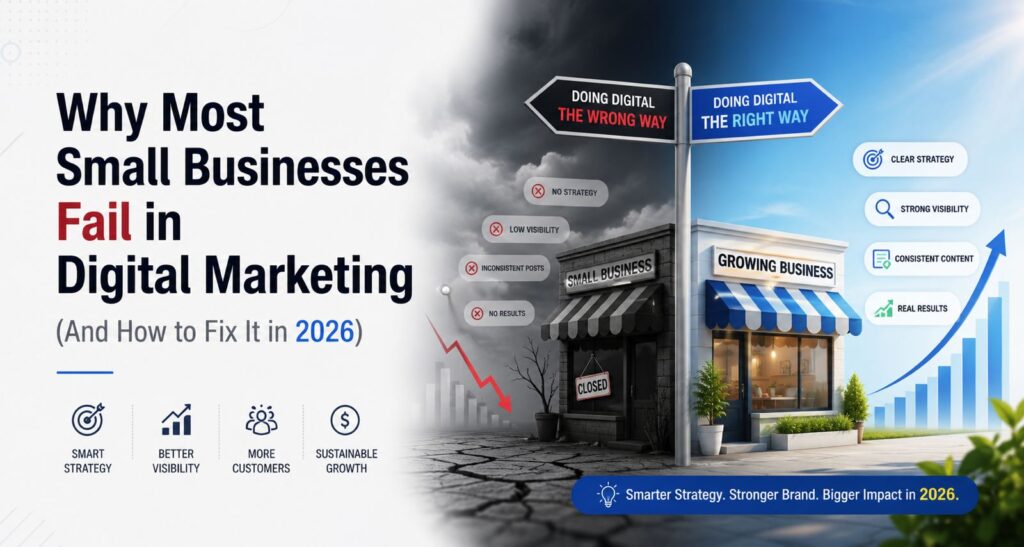
Why Most Small Businesses Fail in Digital Marketing (And How to Fix It in 2026)
Digital marketing has become essential for business growth, yet many small businesses and startups in India still fail to generate results from it. The problem is not the lack of platforms or tools, but the absence of a clear strategy and execution discipline. From my experience working with emerging brands, the majority of businesses approach digital marketing with unrealistic expectations and fragmented efforts. They run ads without understanding their audience, post content without a clear message, and expect immediate results without testing or optimization.
One of the biggest mistakes businesses make is starting without defining their target audience. Instead of focusing on a specific segment, they try to reach everyone, which leads to poor engagement and low conversion rates. In digital marketing, clarity of audience directly impacts performance. When businesses define who they are targeting—based on interests, behavior, and needs—they can create more relevant campaigns that actually connect with users. This is especially important for local businesses in Kerala, where audience behavior can differ significantly from larger metropolitan markets.
Another critical issue is inconsistency. Many businesses start strong but lose momentum within a few weeks. Digital marketing is not a one-time activity; it requires continuous effort. Algorithms favor consistency, and audiences build trust over time through repeated exposure. When businesses stop posting content or pause ad campaigns prematurely, they lose the progress they have built. Sustainable growth comes from long-term commitment rather than short bursts of activity.
A lack of data analysis is another major factor behind failure. Digital platforms provide detailed insights into campaign performance, but many businesses ignore this data. Instead of analyzing metrics such as engagement rate, click-through rate, and conversions, they rely on assumptions. This leads to poor decision-making and wasted budgets. Businesses that succeed in digital marketing treat it as a data-driven process, where every campaign is tested, measured, and optimized.
To fix these issues, businesses need to adopt a structured approach. This includes defining clear goals, understanding the target audience, creating consistent content, and using data to refine strategies. Paid advertising should be combined with organic efforts such as content marketing and SEO to build a balanced growth system. Retargeting should also be implemented to convert users who have already shown interest.
In 2026, digital marketing success is not about doing more; it is about doing things strategically. Small businesses that focus on clarity, consistency, and performance tracking can compete effectively, even with limited budgets. From my perspective, the brands that succeed are not necessarily the ones spending the most, but the ones executing the smartest strategies.